


THE SCIENCE BEHIND PREP The Power and Science Behind PREP’s Simplicity and Validation
PREP’s assessment system reflects nearly 40 years of psychometric research, cross-cultural norming, and longitudinal validation. The instrument measures CORE personality traits and personal resilience through a proprietary algorithm designed for accuracy, cultural neutrality, and practical application.
Explore the Research
PREP vs. Popular Assessments
| Factor | PREP | MBTI | DiSC | Big Five |
|---|---|---|---|---|
| Time to Complete | 5 minutes | 20–30 min | 15–20 min | 15–45 min |
| Reading Level | 8th grade | College | College | College |
| Question Format | Straightforward | Forced-choice | Complex | Complex |
| Stress / Resilience Metrics | ✓ Yes | ✗ No | ✗ No | ✗ No |
| Second-Guessing Risk | Low | High | Moderate | High |
| Recommended as Hiring Tool | ✓ Yes | ✗ No (publisher) | ✗ No (publisher) | Varies |
Multi-Disciplinary Development Model
Built for the Real World
Designed from the ground up to meet your needs.
Most personality assessments follow a familiar path: developed in university labs, validated on college students, then marketed to organizations hoping the research translates. PREP took a harder road – developing an assessment with populations who would use it. We validating the instrument in the professional, personal, and medical realm, gathering data from working professionals at all levels and different generations across industries and cultures. Then working with multiple experts to test what actually predicted performance, personality, and stress. From there, refining the instrument based on real outcomes.
From the beginning, PREP was built to help solve real problems—high-stakes hiring decisions, team dysfunction, leadership derailment, and identifying high functioning burnout. The questions didn’t stop at “How do these constructs correlate with existing measures?” but “What actually works?”
That practical focus shaped everything: the 5-minute format (because busy professionals shouldn’t have to sit for 45-minute assessments), the 8th-grade reading level (because your workforce isn’t homogeneous), and the stress metrics (because personality alone doesn’t predict performance under pressure).
Developed in Collaboration With
- Industry leaders facing real workforce challenges
- Statisticians ensuring psychometric rigor
- Organizational psychologists bridging theory and practice
- Management experts who know how to implement change
- Doctors to integrate the most validated stress and depression metrics
Always Tested for What Works
- Validated in hiring, not just research studies
- Refined through 40 years of real-world application
- Normed on working professionals, not undergraduates
- Continuously updated based on practitioner feedback
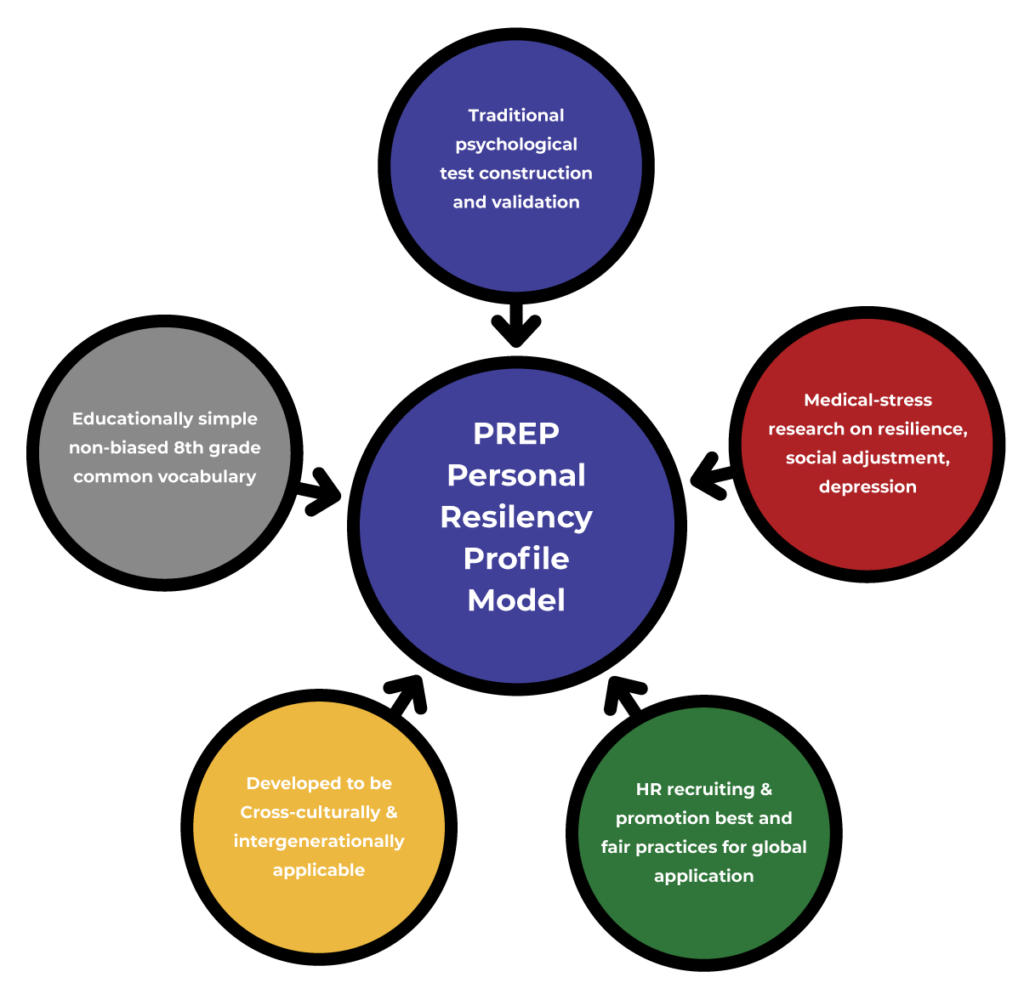
Design Principles
The PREP assessment was developed in 1984 with five foundational requirements:
Linguistic Accessibility: All survey items use validated 8th-grade common reading vocabulary, reducing comprehension barriers across education levels, generations, and cultural backgrounds.
Theoretical Synthesis: The model integrates Jungian typology, Big Five Factor theory, and four-trait quadrant models into a unified framework.
Resilience Measurement: Drawing on the stress-hardiness research of Hans Selye and Suzanne Kobasa, PREP incorporates a proprietary metric for change-readiness and long-term resilience.
Cultural Neutrality: Initial norming targeted a demographically diverse working population across North America. Ongoing re-norming studies continue to validate accuracy across age, gender, ethnicity, geography, and cultural context.
Regulatory Alignment: PREP was designed to meet EEOC and Affirmative Action standards—now referenced under Diversity, Equity, and Inclusion guidelines—ensuring defensible, bias-free application in employment contexts.
Validation Studies
Initial Validation (1984)
Individuals aged 13–92 confirmed reliability of CORE trait measurements and validated the long-term resilience metric.
Longitudinal Cross-Correlation (1991–1992)
Conducted by Dr. Samuel Houston and JoAn Mann. CORE traits were cross-correlated with MBTI and traditional four-quadrant models.
Test-Retest Reliability
90-day test-retest studies produced a .91 reliability factor for traits remaining on the same side of the norm line.
Big Five Cross-Validation (2008–2009)
Most recent cross-validation conducted against the NEO-PI (Big Five Factor model), confirming continued alignment with contemporary personality science.
The PREP Advanced Insights system was developed by JoAn Mann, MBA, GPHR , supported by her team of foundational researchers: Statistician, Dr. Robert (Samuel) Houston, professor emeritus University of Northern Colorado; physician, Dr. Stephen Mann and Statistician Shaun Pichler, professor at Cal State Fullerton, Word Readability expert Dr. Bonnie Orr. IT and Web Development team is led by Josh Chavez of Bluefire Interactive and UX Design & Developer Chris Minney of Tif & Gif Creative. Early web developers include: and Dr. Bjoern Kesper, Norm Orio, Dave Rozar and Jack Menendez.